Epoxy vs Polyurethane Flooring: Which Concrete Floor Coating Is Best?
Choosing the right coating system for a concrete floor is an important decision for industrial and commercial facilities. The wrong flooring solution can lead to premature wear, costly repairs, increased maintenance, and operational disruptions.
Two of the most common high-performance coating options are epoxy and polyurethane (urethane) floor coatings. Both provide excellent protection against abrasion, chemicals, and daily wear, but each system offers different advantages depending on the environment and performance requirements.
At Extreme IFC, we help businesses select and install industrial flooring solutions designed around their facility’s specific needs, including traffic levels, chemical exposure, cleaning requirements, and long-term performance goals.
The best coating choice depends on understanding how epoxy and polyurethane perform in real-world applications.
What Is the Difference Between Epoxy and Polyurethane Floor Coatings?
Although epoxy and polyurethane are both protective resin-based coating systems, they are designed with different performance characteristics.
Epoxy coatings are known for their strong bond to concrete, high build thickness, and excellent durability under heavy loads. Polyurethane coatings are valued for their flexibility, chemical resistance, UV stability, and ability to withstand demanding environmental conditions.
In many industrial applications, these systems are not competitors but complementary solutions. A common approach is using epoxy as a strong base layer with polyurethane as a protective topcoat.
Epoxy Flooring: Strength, Durability, and Concrete Protection
Epoxy flooring is one of the most widely used coating systems for industrial concrete flooring because of its strength, durability, and ability to create a seamless protective surface.
When properly installed, epoxy forms a strong mechanical bond with prepared concrete, creating a durable foundation that can withstand heavy equipment, forklift traffic, impacts, and abrasion.
Benefits of Epoxy Floor Coatings Include:
Excellent Concrete Adhesion
One of epoxy’s greatest advantages is its ability to bond directly with properly prepared concrete. This creates a strong foundation that supports long-term performance.
High Durability
Epoxy coatings provide excellent resistance against:
- Heavy equipment traffic
- Impact damage
- Abrasion
- Wear from daily operations
Customizable Thickness and Performance
Epoxy systems can be customized based on facility requirements, including different thicknesses, textures, colors, and performance additives.
Cost-Effective Protection
Compared with many industrial flooring alternatives, epoxy provides a durable solution with a strong balance of performance and value.
Epoxy flooring is commonly used in:
- Manufacturing facilities
- Warehouses
- Automotive facilities
- Commercial buildings
- Production areas
Learn more about our epoxy flooring systems and how they can protect industrial concrete surfaces.
Polyurethane Flooring: Flexibility and Chemical Resistance
Polyurethane floor coatings provide a high-performance protective layer designed for environments where flexibility, chemical resistance, and environmental exposure are important considerations.
Unlike epoxy, polyurethane offers greater flexibility, allowing it to better handle temperature changes, movement, and thermal shock.
Benefits of Polyurethane Floor Coatings Include:
Superior Chemical Resistance
Polyurethane performs exceptionally well in environments exposed to:
- Chemicals
- Oils
- Cleaning agents
- Industrial contaminants
UV Stability
Polyurethane coatings offer excellent resistance to sunlight and UV exposure, making them ideal for facilities with exterior exposure, loading areas, and areas with natural light.
Flexible Performance
Because polyurethane is more flexible than epoxy, it can better accommodate minor movement and temperature changes in concrete.
Easy Maintenance
The seamless surface created by polyurethane coatings helps reduce dust buildup and makes routine cleaning easier.
For a deeper look at polyurethane applications, read our guide on polyurethane floor coatings.
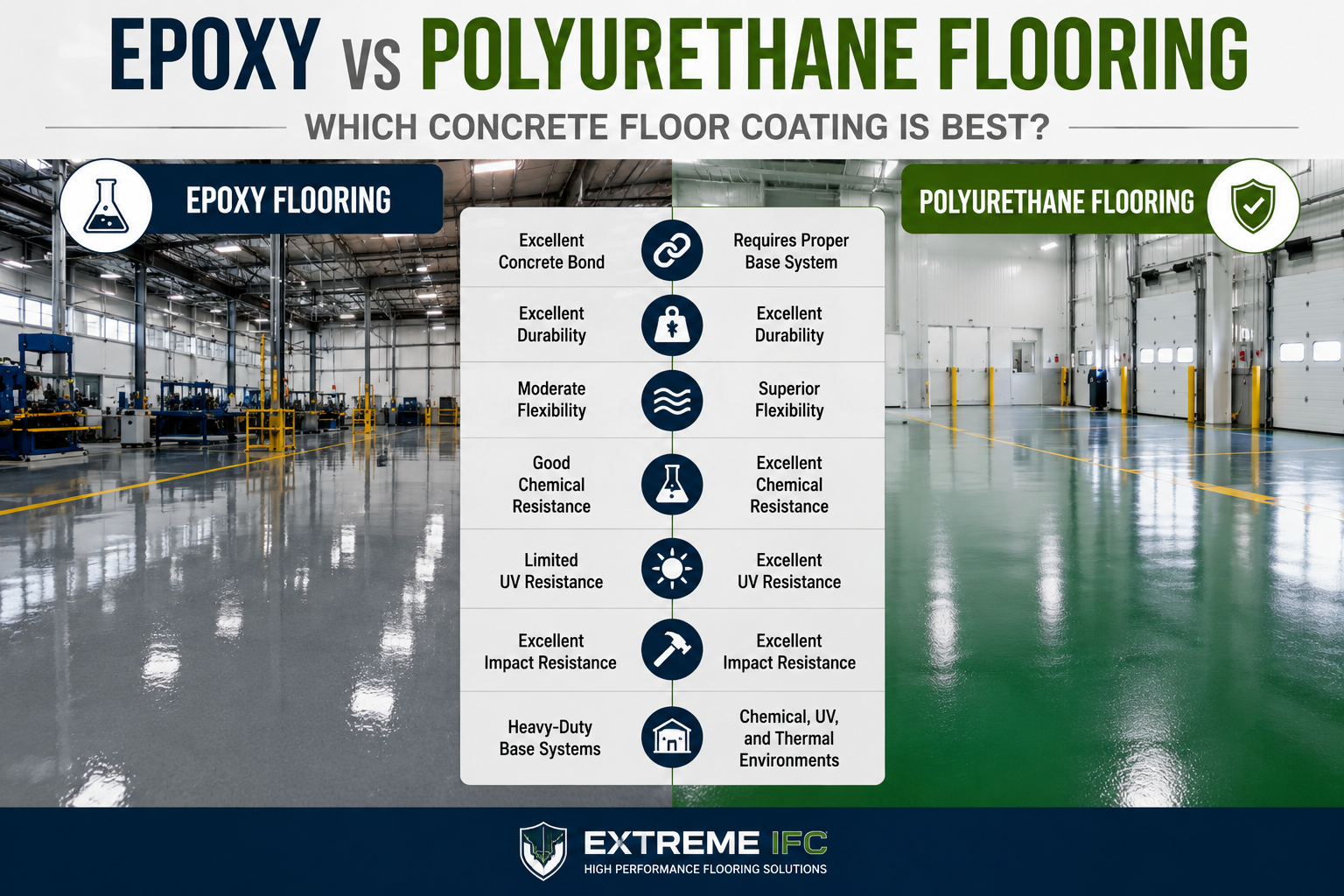
Epoxy vs. Polyurethane Flooring Comparison
Can Epoxy and Polyurethane Be Used Together?
Yes. In many demanding industrial environments, the best flooring system combines both materials.
A common flooring system uses epoxy as the base layer because of its strong adhesion and durability, followed by a polyurethane topcoat to provide additional chemical resistance, flexibility, and UV protection.
This combination creates a high-performance flooring system designed for facilities that experience:
- Heavy traffic
- Chemical exposure
- Frequent cleaning
- Temperature changes
- Aggressive operating conditions
Which Flooring System Is Right for Your Facility?
The best coating solution depends on your facility’s unique requirements.
Epoxy may be the better choice when you need:
- Strong concrete adhesion
- Heavy-duty protection
- High-impact resistance
- A durable resurfacing solution
Polyurethane may be the better choice when you need:
- Chemical resistance
- UV stability
- Greater flexibility
- Protection against temperature changes
In some cases, a combined epoxy and polyurethane system provides the best long-term performance.
Working with an experienced industrial flooring contractor ensures your coating system is selected and installed correctly for your environment.
Why Choose Extreme IFC for Concrete Flooring Solutions?
At Extreme IFC, we specialize in designing and installing high-performance flooring systems for industrial and commercial facilities throughout Georgia.
Our team evaluates your facility’s operating conditions, including traffic patterns, chemical exposure, maintenance requirements, and performance expectations, to recommend the right solution.
From industrial concrete flooring systems to customized coating applications, we help businesses create safer, more durable, and longer-lasting concrete surfaces.
Frequently Asked Questions
Is polyurethane better than epoxy flooring?
Neither coating is universally better. Epoxy offers excellent strength and concrete adhesion, while polyurethane provides superior flexibility, chemical resistance, and UV protection. The best choice depends on your facility’s needs.
What lasts longer, epoxy or polyurethane?
Both systems can provide long-lasting performance when properly installed and maintained. The lifespan depends on traffic levels, environmental conditions, preparation, and maintenance practices.
Can polyurethane be applied over epoxy?
Yes. Polyurethane is often installed as a topcoat over epoxy to provide additional protection against chemicals, UV exposure, and wear.
What is the best coating for industrial concrete floors?
The best coating depends on the environment. Industrial facilities should consider traffic, chemicals, temperature changes, cleaning requirements, and expected floor performance before selecting a system.
Protect Your Concrete Floors With the Right Coating System
Choosing between epoxy and polyurethane flooring is an important investment in the safety, efficiency, and longevity of your facility.
Whether you need a durable epoxy system, a chemical-resistant polyurethane coating, or a customized combination of both, Extreme IFC can help design the right flooring solution for your operation.
Contact our team today to discuss your concrete flooring needs and discover how a professionally installed coating system can improve your facility.
Will Gleeson
With nearly 20 years in resinous flooring, Will Gleeson started as a floor installer and technician and worked his way into company leadership. He specializes in epoxy and urethane flooring systems, material selection, surface preparation, technical specifications and installation methods, and still oversees flooring designs, specs and project pricing. Will holds manufacturer certifications with Sika, Key Resin, Sherwin-Williams and Dudick/Carboline, and has helped Extreme IFC earn multiple Sika Project of the Year awards and Sika Master Installer status.